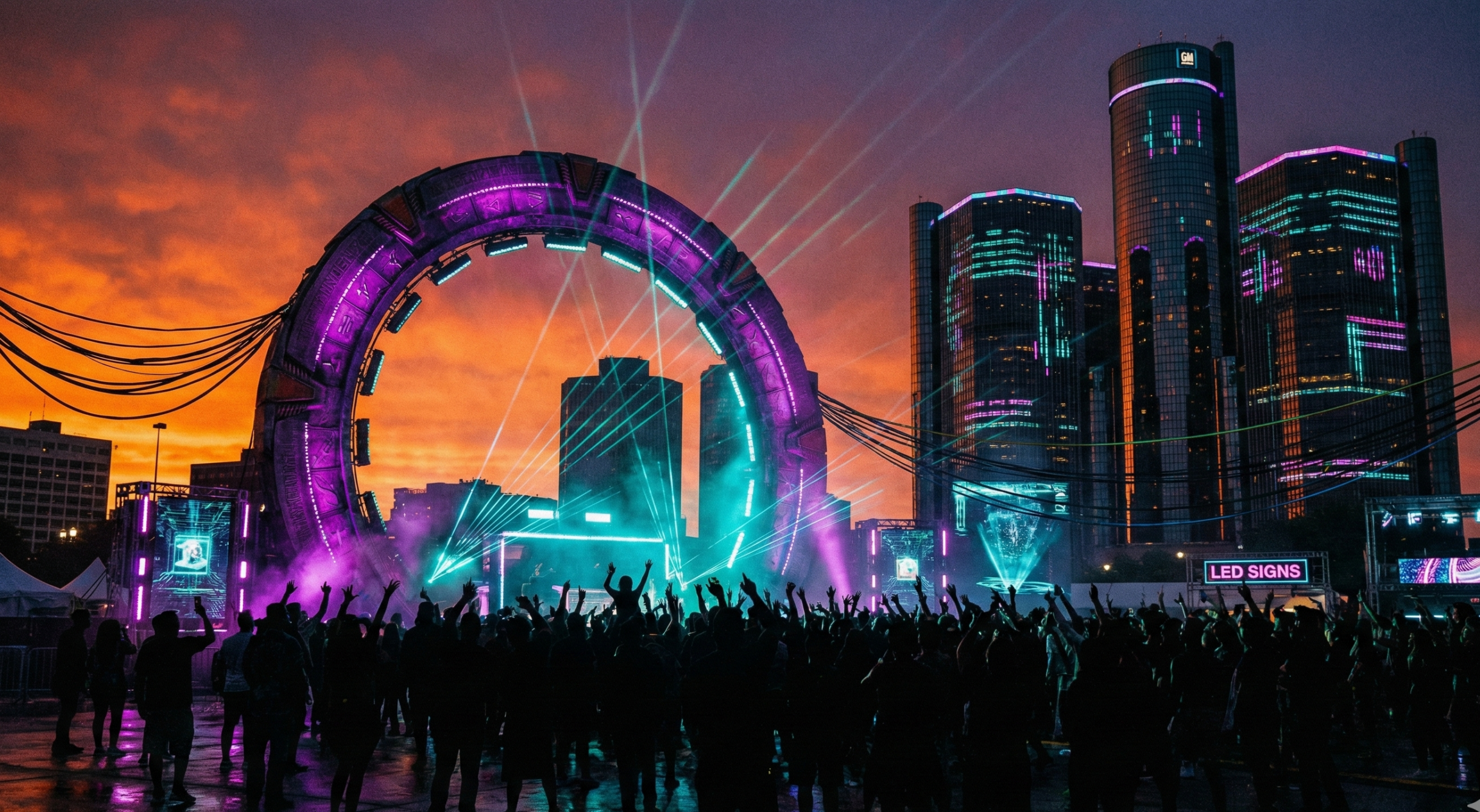
In the year 2000, Detroit threw a party, and the whole world showed up.
In our Series Finale, we take you to Hart Plaza for the birth of the Detroit Electronic Music Festival (DEMF/Movement). We explore how a free festival saved the scene and turned the city into a global pilgrimage site every Memorial Day.
We also dive into the high-speed world of Ghetto Tech with DJ Godfather and introduce the new generation of artists (Kyle Hall, Jay Daniel) who are proving that the Motor City is still the engine of future sound.
https://omny.fm/shows/the-detroit-party-podcast/movement-the-festival-the-future-the-legacy-2000-present
Beyond the Belleville Three: 4 Surprising Truths of Modern Detroit Techno
When you think of Detroit music, your mind might jump to the soulful harmonies of Motown or the revolutionary futurism of the first wave of Techno pioneers. The story of Juan Atkins, Derrick May, and Kevin Saunderson is legendary, a tale of post-industrial innovation that sent an electronic pulse around the world. But what if the most vital part of the story isn’t just how it began, but what happened next?
The last 25 years of Detroit’s electronic music scene reveal a story of resilience, evolution, and community that often gets overlooked. The narrative didn’t end in the 90s; in many ways, it was just getting started. But the entire story pivoted on a single weekend in 2000, when a free party on the riverfront accidentally became a global declaration.
Here are four surprising truths about Detroit’s electronic music scene that have unfolded since that pivotal moment.
Four Surprising Truths About Modern Detroit Techno
1. A Free Party Accidentally Became a Global Phenomenon
In 2000, local producer Carol Marvin and legendary artist Carl Craig launched the Detroit Electronic Music Festival (DEMF). The plan was simple: a free event for the city, held in Hart Plaza right on the riverfront. Expectations were modest; no one was sure who would show up.
The reality was staggering. Over one million people attended that first weekend. It was the moment Detroit realized, “Wait, the whole world loves our music?” The crowd wasn’t just made up of underground ravers; it was a cross-section of Detroit itself. As one account described it, “Families, grandmothers, and ravers… dancing together.” A free party became a powerful statement, proving that the world was not only listening but was ready to come to the source.
2. The Spiritual Home of Techno is a Concrete Amphitheater
For electronic music fans, Hart Plaza is hallowed ground. This downtown “concrete amphitheater” is widely considered the spiritual home of Techno. Dominated by a massive stainless steel ring sculpture officially named Transcendence but known to all as the “Stargate,” the plaza is more than just a venue; it’s a destination.
Every Memorial Day weekend, this space transforms into a modern-day Mecca. Techno pilgrims travel from Berlin, Tokyo, London, and beyond to experience the music in its birthplace. Standing within the concrete confines of the plaza, they come to pay homage to the city that started it all.
3. While the World Celebrated Techno, Detroit’s Streets Moved Faster
While international pilgrims flocked to Hart Plaza to gaze at the “Stargate,” a different, faster rhythm was taking hold in Detroit’s own neighborhoods. Ghetto Tech emerged as the raw, high-speed soundtrack for the city, a gritty counterpoint to the more polished “main export” being celebrated on the global stage.
Pioneered by figures like DJ Godfather and DJ Assault, the style is defined by extremely fast beats—often between 145 and 160 BPM—and explicit lyrics, fueling a frenetic style of footwork dancing called “Jitting.” While the world looked at the festival, Ghetto Tech kept the music grounded in the neighborhood parties, not just the big festivals, proving the city’s electronic heart was beating to more than one drum.
4. The New Generation Isn’t Just a Tribute Act
The story of Detroit’s innovation didn’t stop with the founding fathers. A new guard of artists, born in the 90s, grew up with the festival’s legacy, inheriting not just a sound but a global stage. Producers like Kyle Hall, Jay Daniel, and Waajeed are forging their own path.
This new generation carries a deep respect for the history created by the Belleville Three, but they refuse to be a tribute act. Their mission is to evolve the sound, not just replicate it. By weaving elements of Jazz, Hip Hop, and House back into the fabric of Techno, they are proving that the Motor City is still a powerful engine for musical innovation.
The Folk Music of the Future
From the mechanical rhythms of Ford’s assembly lines to the synthesized patterns of Juan Atkins’ drum machines, the sound of Detroit has always been a direct product of its environment. The city’s industrial soul didn’t just fade away; it was reprogrammed, finding new life in the circuits and software that would define the next century. This connection between the city and its sound continues to power its legacy as a global creative force.
Techno is not just dance music. It is the folk music of the industrial age.