The Mothership Connection: How a Visionary DJ Built Detroit Techno from the Ashes of the Motor City
Introduction: The Sound of Silence
In the early 1970s, Detroit fell silent. The city, once the roaring engine of American industry and culture, was hollowed out by a one-two punch that dismantled its identity. In 1972, Motown Records, the hit-making machine that had defined “The Sound of Young America,” packed its bags for Los Angeles, creating a profound cultural void. A year later, the 1973 OPEC oil embargo crippled the auto industry, triggering an economic freefall. This period, roughly from 1973 to 1985, became “The Bridge”—a time of decay and uncertainty. Into this silence stepped a visionary voice from the radio airwaves: The Electrifying Mojo. He became the architect of a new soundscape, using his late-night broadcasts to piece together the fragments of funk, soul, and European electronica. Unknowingly, he was providing the sonic blueprint for Detroit Techno, a new global sound forged in the quiet ruins of the Motor City.
——————————————————————————–
1. A City in Crisis: The Detroit Vacuum
Detroit’s identity was built on two pillars: music and manufacturing. In just two years, both crumbled.
The first blow came when Motown Records completed its relocation to California in July 1972. The move was a practical and psychological disruption. At its peak, the company employed 300 people in Detroit; after the move, that number dropped to fewer than 100. Critically, the creative soul of the operation was left behind. Very few members of the legendary house band, the Funk Brothers, relocated, severing the city from its signature sound.
The second blow struck the city’s economic heart. The 1973 oil embargo, declared by the Organization of Petroleum Exporting Countries (OPEC), sent shockwaves through the American auto industry. Oil prices quadrupled, and consumer demand abruptly shifted away from the heavy, gas-guzzling cars that were Detroit’s specialty. As Japanese automakers flooded the market with smaller, fuel-efficient vehicles, Detroit’s giants—General Motors, Ford, and Chrysler—stumbled. The crisis led to devastating job losses, accelerated “white flight” to the suburbs, and left behind a landscape of industrial decay.
2. The Architect of the Airwaves: The Electrifying Mojo
From this vacuum emerged Charles Johnson, a radio DJ who broadcast under the pseudonym The Electrifying Mojo. He was the primary catalyst for the city’s musical rebirth. His philosophy was one of “counter-clockwiseology”—a deliberate defiance of the era’s racially and generically segregated radio formats. He treated his show not as a playlist, but as a “sonic journey,” exposing a generation of listeners to a radical, eclectic mix.
Mojo acted as a musical guru, a professor of sound for a city that had lost its way. He would often play entire 20-minute album sides without interruption, demanding full immersion from his audience. His playlist was a testament to his boundary-breaking vision:
- George Clinton’s Parliament-Funkadelic: Intergalactic funk that offered an escape.
- Kraftwerk: Robotic, futuristic electronica from Germany.
- The B-52’s: Quirky new wave from the American South.
- Prince: Genre-bending funk-rock-pop from Minneapolis.
- Frank Zappa: Experimental, iconoclastic rock.
By refusing to categorize music, Mojo created a shared soundscape for a divided city and planted the seeds for a new musical form.
3. The Midnight Funk Association: A Ritual for a Divided City
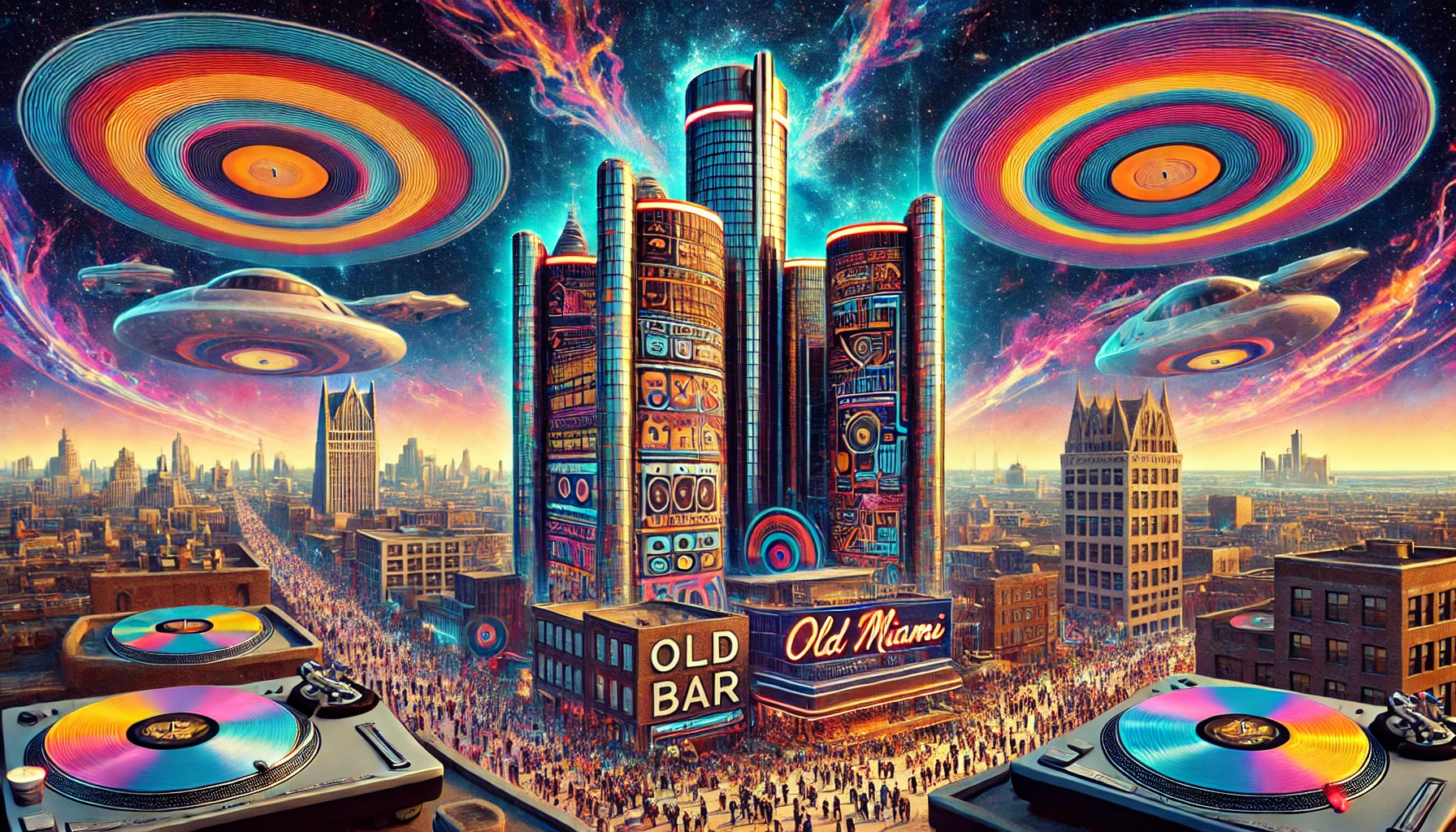
Mojo’s most influential segment was the Midnight Funk Association (MFA). It was more than a radio show; it was a nightly ritual. He would open the segment with a ceremonial “landing of the mothership,” complete with space-age sound effects, over downtown Detroit.
He cultivated a sense of community by encouraging participatory rituals. Listeners were instructed to turn on their porch lights to “show solidarity.” Those driving were told to honk their horns and flash their headlights. It was a call for connection in a city marked by division. Mojo’s broadcasts were also a source of empowerment, delivering monologues that spoke directly to the struggles of his audience. His most famous declaration became a mantra for many:
“Whenever you feel like you’re nearing the end of your rope, don’t slide off. Tie a knot. Keep hanging… there ain’t nobody bad like you”.
4. The Sonic Blueprint: Afrofuturism and the Machine
Mojo championed two seemingly disparate sounds that, when combined, would form the DNA of techno. This sonic alchemy—fusing the soul of the cosmos with the rhythm of the assembly line—was the core insight of Detroit’s next musical revolution.
4.1 The Soul of the Mothership
The “Mothership” was a concept borrowed from George Clinton and his funk collective Parliament-Funkadelic, whose 1975 album Mothership Connection became a cornerstone of Mojo’s show. The P-Funk mythology used science fiction as a powerful metaphor for Black empowerment and social salvation. For a community facing industrial collapse and social marginalization, the idea of escaping to a “Chocolate Milky Way” on an extraterrestrial mothership was a potent form of Afrofuturist escapism. This vision moved the Black subject beyond terrestrial struggles, from “African-American” to an “equal citizen” of the cosmos.
4.2 The Pulse of the Factory
The second key ingredient was the sound of the German electronic band Kraftwerk. Their robotic, mechanical, and futuristic music resonated deeply with the youth of Detroit. In a city defined by the rhythms of the assembly line—even as those lines were grinding to a halt—Kraftwerk’s disciplined, synthesized pulse felt like the sound of the post-industrial future. This was not merely an appreciation of a foreign sound; it was an act of reappropriation. The children of autoworkers heard the noise of the machines that were failing their parents and, through Kraftwerk, envisioned a way to repurpose that sound as art. It was a fusion of dystopian funk and industrial reality, a creative act born from, as Cybotron’s Rik Davis would later describe his childhood, a “post-industrial wasteland.”
5. The Birth of Techno (1981–1985)
The direct heirs of Mojo’s sonic experiments were three high school friends from the suburb of Belleville who listened to his show “religiously.”
5.1 The Apprentices from Belleville
Juan Atkins, Derrick May, and Kevin Saunderson—known collectively as “The Belleville Three”—were the first to consciously synthesize the two poles of Mojo’s playlist. They heard the connection between the soulful, intergalactic funk of P-Funk and the cold, disciplined electronic sound of Kraftwerk. They understood that these were not opposing forces but two sides of the same futuristic coin. Fusing the desire for escape with the sonic reality of their environment, they set out to create a new music that forged an identity from the ruins.
5.2 The Spark: “Alleys of Your Mind”
The first definitive Detroit techno record was born from a collaboration between Juan Atkins and Rik Davis, a Vietnam veteran who had fought in the Tet Offensive and used his army disability pay to purchase synthesizers. They formed the group Cybotron in 1981. After recording a demo for their track “Alleys of Your Mind,” the mission to get it on the air fell to Atkins’s best friend, Derrick May.
May, a devoted fan of the arcade game Defender, knew that Mojo often wound down at a local café after his show. He strategically waited there, playing the game, until the DJ appeared. May approached his idol with the demo tape. At the time, Mojo was on a “reggae excursion.” He put the cassette on without taking the reggae record off his turntable and issued a challenge: “If your track makes me take off the record, then it’s a hit.” As the raw, alien pulse of Cybotron’s track filled the room, Mojo lifted the needle. Two days later, “Alleys of Your Mind” was on the radio.
The response was immediate. The single became a local hit, selling over 10,000 copies. Its sound was so futuristic and unfamiliar that it defied classification. “I had people come up to me and say they thought Cybotron was some white guys from Europe,” Atkins recalled. “People couldn’t believe we were actually Detroit musicians.” It was the moment of validation. A sound conceived in a suburban basement, inspired by a visionary DJ, and broadcast across a struggling city had now become a tangible movement.
6. Conclusion: From Motor City Soul to a Machine-Driven Future
The Electrifying Mojo was the crucial bridge between Detroit’s past and its future. He took the cultural void left by Motown and the economic despair caused by the auto industry’s collapse and filled it with a new, forward-looking mythology. In 1985, Juan Atkins released “No UFOs” under the name Model 500, a record that solidified the transition from the organic “Motown Sound” to a new, machine-driven identity for Detroit. This new sound was the music of a city forced to reinvent itself from the factory floor up.
If Detroit was a factory that had been shut down, The Electrifying Mojo was the rogue engineer who hot-wired the sound system. He used the “Mothership” as a blueprint to show the workers that even if the assembly lines had stopped, they could use the same machines to build a rocket to the stars.