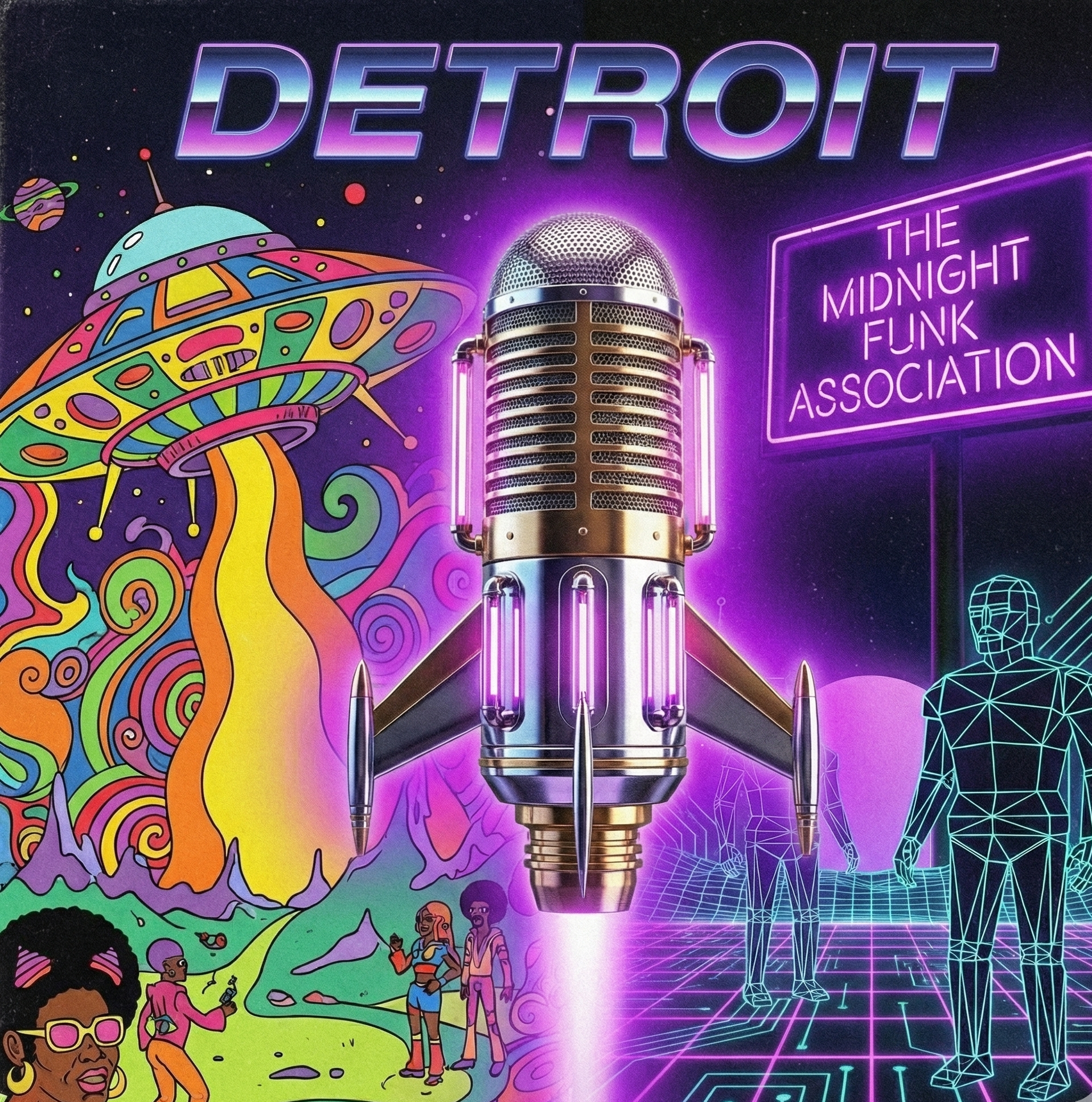
Motown left town, but the music didn’t die—it just got weird.
In Episode 3, we bridge the gap between the guitar riffs of the 60s and the drum machines of the 80s. We track the landing of George Clinton’s P-Funk Mothership and the arrival of Kraftwerk’s German robots.
But the real hero of this story is a mysterious voice on the radio: The Electrifying Mojo. Join us for a meeting of “The Midnight Funk Association” to understand how one DJ broke every rule in the book and taught Detroit how to dream of the future.
https://omny.fm/shows/the-detroit-party-podcast/the-mothership-the-electrifying-mojo-how-radio-changed-the-world-1973-1985
5 Surprising Ways Detroit’s Collapse Fueled a Global Music Revolution
Introduction: From Motor City to Techno City
When we think of Detroit, we think of two sounds. The first is the city itself: the percussive roar of the factory, the metallic heat of the assembly line, the boomtown symphony of industrial might. This was the sound that birthed its polished musical counterpart: the immaculate harmonies and chrome-plated soul of Motown Records, the self-proclaimed “Sound of Young America” that soundtracked an era of seemingly boundless prosperity.
But there is a second, stranger story. It’s a tale of how, from the silence of shuttered plants and the ashes of economic collapse, a radically new sound emerged. This is the story of Detroit techno, a futuristic, machine-driven music born not from a city at its peak, but from one in a state of profound crisis. It is the counter-intuitive history of how the painful death of one American dream unexpectedly fueled a global music revolution.
1. One City, Two Revolutions: From Boomtown Soul to Post-Industrial Futurism
Motown and techno are both quintessentially Detroit, yet they were born from starkly different economic worlds. Motown was the sound of peak America. At the auto industry’s mid-century zenith, the Detroit-based “Big Three”—General Motors, Ford, and Chrysler—were the engine of the national economy, with one in six working Americans employed directly or indirectly by the industry. Motown’s optimistic soul was the perfect soundtrack for this era.
By contrast, Detroit techno emerged in the 1980s from a city hollowed out by deindustrialization. The decay had been creeping in for decades; between 1948 and 1967, the city lost over 130,000 manufacturing jobs. The 1973 oil crisis then dealt a devastating blow to the industry’s gas-guzzling behemoths, and rising competition from fuel-efficient Japanese cars accelerated the decline.
For the young Black artists who created techno, this was not an abstract economic trend; it was the landscape of their lives. They grew up in what Cybotron’s Richard Davis called a “post-industrial wasteland.” Davis described his own old neighborhood as a place where his “childhood no longer exists,” a ruin with “not a brick left standing.” In a city where the primary machines—the assembly lines—were falling silent, these artists repurposed the rhythm of the machine for a new generation. They reclaimed their city’s industrial identity, creating a stark, futuristic machine music from the scraps of a world that had been abandoned.
2. The Unlikely Godparents: German “Robot Pop” and Afrofuturist Funk
The creators of Detroit techno were sonic architects, fusing together two radically different and seemingly incompatible influences that were being broadcast into their homes from across the Atlantic and from just across town. It was a collision of opposites that made perfect sense in Detroit: the sterile, post-war European machine aesthetic meeting the flamboyant, diasporic futurism of Black America.
The first source of inspiration was the German band Kraftwerk. Hailing from Düsseldorf, another industrial city, Kraftwerk pioneered a style they called “robot pop” out of West Germany’s experimental “krautrock” scene. Their music was defined by sparse arrangements, repetitive electronic rhythms, and a deep fascination with technology. It was cold, precise, and sounded like the future.
The second, and wildly different, influence was the psychedelic, sprawling funk of George Clinton’s Parliament-Funkadelic (P-Funk). Based in Detroit for much of their heyday, P-Funk’s music was built on a foundation of Afrofuturism, using science fiction concepts to create a mythological universe of its own. As Clinton explained, the goal was to put “black people in situations nobody ever thought they would be in, like… outer space.” Their sound was warm, gloriously chaotic, and deeply funky.
Techno pioneer Derrick May perfectly summarized how these two worlds collided to create a new one:
“like George Clinton and Kraftwerk caught in an elevator, with only a sequencer to keep them company.”
3. The Catalyst: A Single, Rule-Breaking Radio DJ
How did these disparate sounds find their way into the ears of Detroit’s youth? The answer lies with one man: a radio DJ named Charles Johnson, better known as The Electrifying Mojo.
Mojo’s late-night show, “Midnight Funk Association,” was unlike anything else on the air. In an era of tightly controlled formats, he was a rebel. He would play entire album sides, mix genres with abandon, and give airtime to artists no one else would touch. In a single set, listeners could hear Parliament, Kraftwerk, Prince, and British new wave bands like The Human League. At the start of his show, he’d perform a ritual, asking members of the “Midnight Funk Association” to rise, turn on their porch lights, and honk their car horns in solidarity, creating a powerful sense of an underground community connected across the airwaves.
Crucially, Mojo was the first to play early Detroit techno on the radio, giving the nascent scene its first platform. When the duo Cybotron finished their first single, “Alleys of Your Mind,” it was Mojo who broke the record to a generation of future producers listening intently in the dark. As techno originator Juan Atkins recalled, Mojo’s impact was profound.
“He was an underground cult hero. We would listen to him religiously every night.”
4. The Human Engine: How a Vietnam Vet’s Disability Pay Funded Techno’s First Album
The story of techno is often told through its technology—synthesizers, drum machines, and sequencers. But the story of its very first album is grounded in a deeply human, messy, and historical reality. The foundational techno act was Cybotron, a duo comprised of a young Juan Atkins and a Vietnam War veteran named Richard “3070” Davis.
The financing for their early, scene-defining singles—which were compiled into the first-ever techno album, 1983’s Enter—didn’t come from a record label advance or corporate money. It came from Richard Davis’s army disability pay. Davis had fought in the Vietnam War and survived the Tet Offensive, and it was his veteran’s benefits that provided the seed money for this new art form.
This fact is remarkable because it reveals the literal human engine behind the machine music. The cold, futuristic, and precise sound of early techno was not built in a sterile lab; it was built on a foundation of national conflict and personal sacrifice. In a city searching for a new engine after its industrial heart had failed, it was a veteran’s personal history that fueled the first sparks of a cultural revolution.
5. The Great Escape: How Motown’s Exit Created a Creative Vacuum
In one of music history’s great ironies, the departure of Detroit’s first musical dynasty inadvertently cleared the stage for its second. In July 1972, Motown Records substantially completed its relocation to Los Angeles. Founder Berry Gordy’s ambitions had shifted towards Hollywood, and he took his stars with him.
But the move wasn’t a clean break that killed the music overnight. Motown artists like Stevie Wonder and The Temptations were still releasing #1 hits that year. The real damage was slower and more structural. The relocation triggered a massive “brain drain,” hollowing out the city’s musical infrastructure. Key figures like executive Barney Ales refused to move. Crucially, very few members of the legendary house band, the Funk Brothers—the musicians who had crafted the iconic “Motown Sound”—relocated to the West Coast.
Over the next decade, this slow decay created a creative void. With the polished, hit-making machine of the “Sound of Young America” gone, a space opened up. A new, grittier, do-it-yourself musical culture would eventually emerge from the underground to fill that vacuum, trading pristine pop for raw, electronic futurism.
Conclusion: A New Sound from the Rubble
Detroit techno was more than just a new genre. It was a defiant creative response to urban decay, an act of world-building when the present seemed bleak. This was a sound born from a perfect storm of decay and innovation: a creative void left by a departed soul empire, filled with German robotics and Afrofuturist funk, broadcast by a rule-breaking DJ, and funded, in a final, profound irony, by a veteran’s sacrifice in a city searching for a new engine. Its pioneers took the sounds of industrial collapse and transformed them into a rhythm that would conquer the world.
It makes you wonder: in the overlooked and struggling cities of today, what future-defining sounds are being born right now?